
This site uses the British Museum reconstruction associated with Irving Finkel, not an original ancient rulebook. New players usually do not get stuck on the board shape. They get stuck on three smaller questions: how a piece enters, where it can be sent back to start, and when a piece near home still cannot bear off. Once those click, Ur stops feeling random and starts feeling readable.
Get started in 30 seconds
You do not need to memorize this page before game one. These five steps are enough to get started, then learn the rest by playing:
- White always rolls first. If you choose Black against AI, the AI takes the opening turn.
- Each turn, roll the four binary sticks for a number from 0 to 4, then tap a highlighted piece. A highlight means that piece can legally use the roll.
- A piece at the start can enter on 1 to 4. A 0, or a roll with no legal move, passes the turn immediately.
- Landing on an opponent on the shared alley sends that piece back to start. The centre rosette (square 4) is the exception: a piece sitting there cannot be captured.
- The first player to bear all seven pieces off on exact counts wins. Too large a number cannot force a piece off.
For game one, watch three things: can a new piece enter, is the landing square safe, and can a piece bear off exactly? If you keep those in view, you are already making real decisions instead of guessing.
How to read the board
The reconstructed board has 20 squares. White uses the bottom track, Black uses the top track, and both share the middle alley. The remaining squares belong to one side or the other, so the opening feels safer than the middle game.
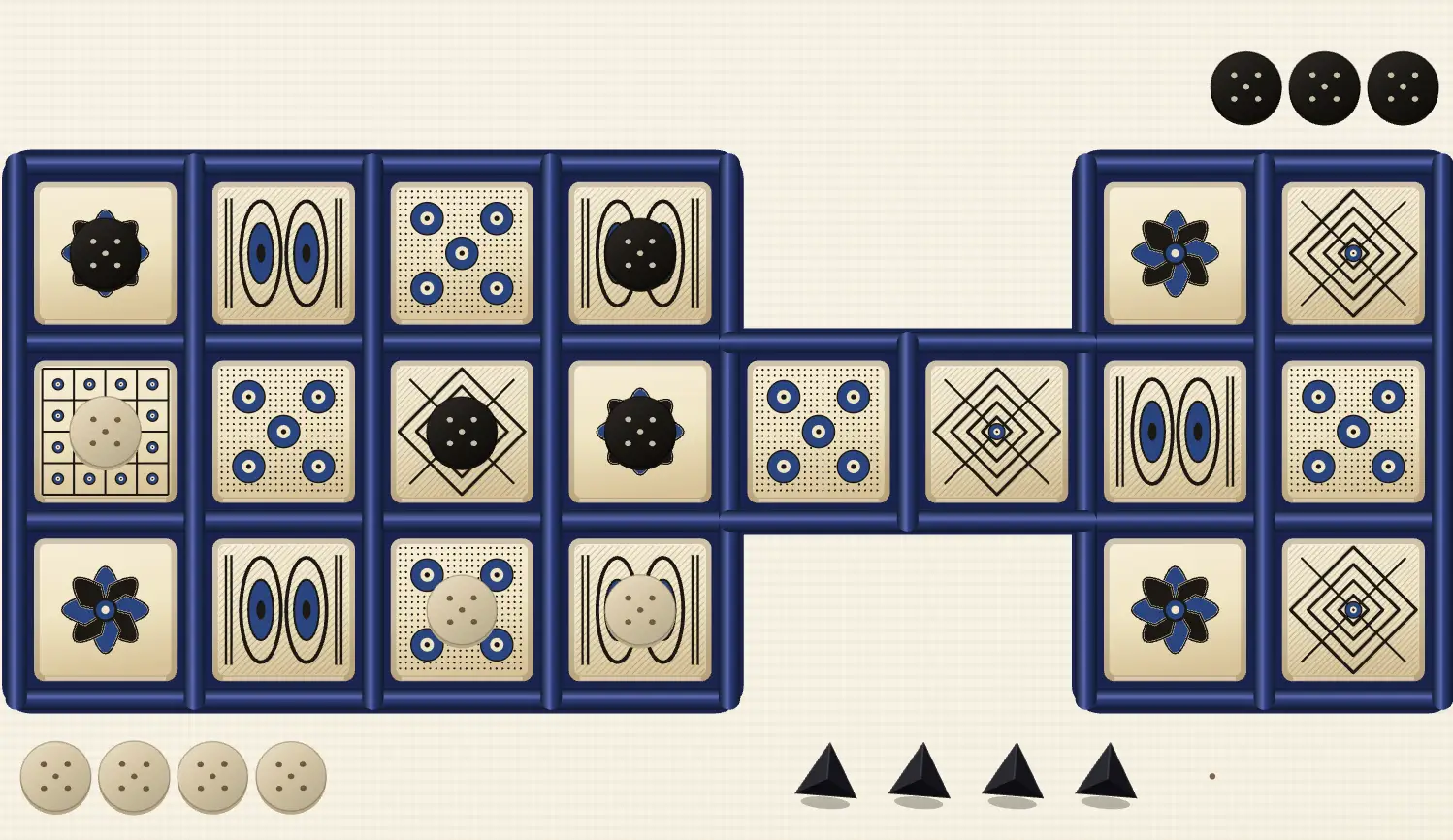 Left private sideShared alleySafe center rosetteRight private side
Left private side: This whole section belongs to one player only, so the opponent cannot capture you here.
Shared alley: The horizontal run through the middle is the shared alley, and most captures happen there.
Safe center rosette: This rosette cannot be captured, and landing on it grants another roll.
Right private side: The other player has a matching private section, and pieces return to that side after the shared alley before bearing off.
After leaving the start, a piece travels its private path, then the shared alley, then its own exit squares. The last step must be exact. If the roll is too large, that piece cannot bear off, so you choose another piece or pass.
How a turn works
A turn has only two steps: roll, then tap a piece that can use that number. The board highlights legal choices, so you do not have to calculate every route yourself. A 0, or a roll with nothing highlighted, hands the turn over.
Pieces still at the start can enter on 1 to 4. If you already have pieces on the board, you may use the same roll on one of those instead. Friendly pieces do not capture each other, so spreading them out usually keeps more options open than shoving one piece forward every time.
Captures and the safe square
The real tension usually starts on the shared alley: can you land on them, or can they land on you? Landing exactly on an opponent there sends that piece back to start. The center rosette is the exception. A piece sitting on that square cannot be captured.
Not every square is dangerous. Private tracks never meet the opponent, so the opening steps are relatively safe. The real threat begins where the paths overlap. Beginners often grab every capture they see; checking whether the landing square survives the reply is usually the better habit.
When you roll again
Landing on any rosette grants another roll. Its value is not just extra movement. It gives you another decision right away: keep pressing, bring out a new piece, or step onto a square your opponent wanted.
A capture by itself does not grant an extra roll. The extra roll still has to be legal. If you then roll a 0, or have no move, the turn ends as usual.
How you win
The first player to bear all seven pieces off wins. Captures do not score, and there is no separate point tally. It is easy to get distracted by one more hit; the race is still about getting every piece off, and doing it sooner than the other side.
Online rooms allow resigning or offering a draw. AI and pass-and-play games allow resigning, or simply starting a new game. If both sides agree to a draw, the site records it as a draw.
What changes by mode
All three modes use the same reconstructed rules. The difference is who you play and which tools you get. The home-page AI game offers hints, undo, and move-by-move replay. Pass-and-play has undo and replay, but no hints. Online rooms share the same sticks and position, allow resigning or a draw offer, and do not allow one-sided undo.
If you just finished this page, the best next step is not another rules page. Open a game against AI, send a piece out, see how the center rosette changes a turn, and notice how a greedy capture can backfire. After one full race, the Royal Game of Ur strategy guide will be much easier to use.
Common questions
Why does a 0 pass the turn?
The four binary sticks produce only 0 to 4. A 0 means there is no distance to move, so the turn ends even if you already have pieces on the board.
Is the centre rosette really safe?
Yes. The middle square of the shared alley is safe from capture. Other rosettes grant another roll, but they do not protect a piece from being sent back.
Why must bear-off be exact?
That is the reconstruction used here. If a piece is two squares from the exit, you need a 2. A larger number cannot force it off, so you move another piece or pass the turn.
Is this the original ancient rulebook?
No. This site uses the popular British Museum reconstruction. Other modern versions may differ on extra rolls, safe squares, and the sticks. Trust the highlights on this board.
Does White always start?
Every mode begins with White rolling first. Against AI you may choose White or Black; if you choose Black, the AI rolls first.
Who rolls the sticks in an online room?
The room service rolls them, so both players see the same 0 to 4. A browser cannot choose the number or change the roll on its own.