
Royal Game of Ur vs AI
How to Play Ur
Ur looks easy right up to the moment the position stops being obvious. Do you bring out a second piece, fight for a rosette, or pass on a capture to keep your bear-off count clean? This version lets you play through those choices against multiple AI levels, then review them with hints, undo, and replay.
Where It Comes From
The Royal Game of Ur was played in ancient Mesopotamia, but no complete rulebook survived to tell us exactly how every turn worked. The version most people know today is a modern reconstruction built from excavated boards, later written evidence, and the British Museum work associated with Irving Finkel. That is the ruleset this site follows. Instead of leaving those ideas on a separate rules page, we put them directly into play: the shared middle alley, the safe center rosette, captures that send a piece back to start, and bear-offs that have to land exactly. The AI levels, hints, undo, and replay are here to help you learn that reconstruction by playing it.

Why a Second Piece Matters
Ur looks much simpler when you only have one active piece. With a single runner on the board, a lot of rolls more or less play themselves. The moment a second piece enters, the same number can mean a capture, a rosette, cover, or cleaner timing for an exact bear-off. Unless the front piece already has a forcing move, getting a second piece into play usually gives you more than a few extra squares ever would.
The Center Rosette Matters
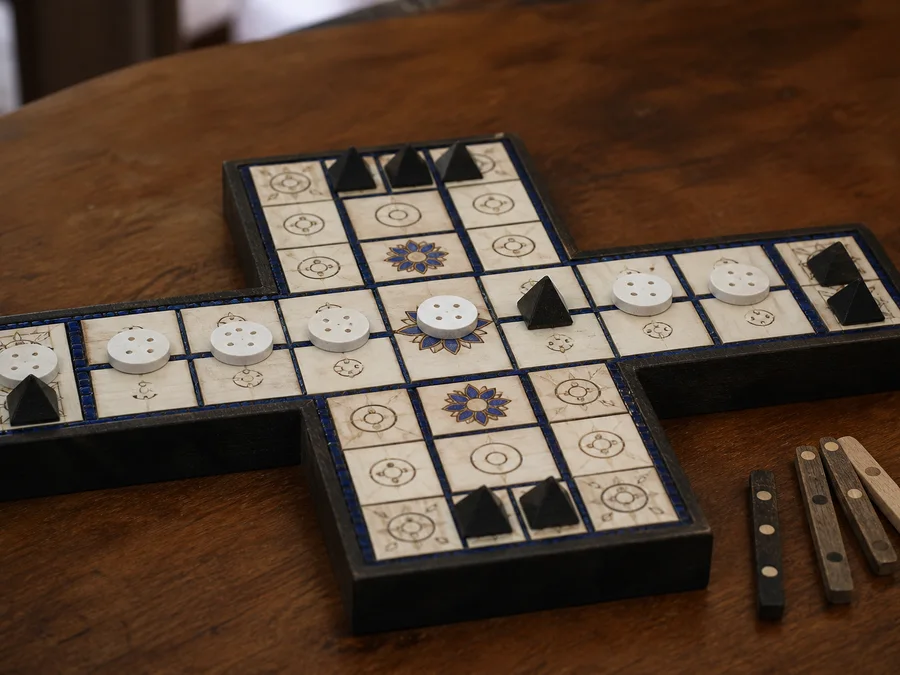
Most of the danger in Ur lives in the shared middle alley, where one capture sends a piece all the way back to the start. The center rosette sits right in that traffic and changes the usual math: a piece there is safe, and landing there gives you another roll. In real games, that often matters more than a move that simply gains distance.
What Each Level Punishes
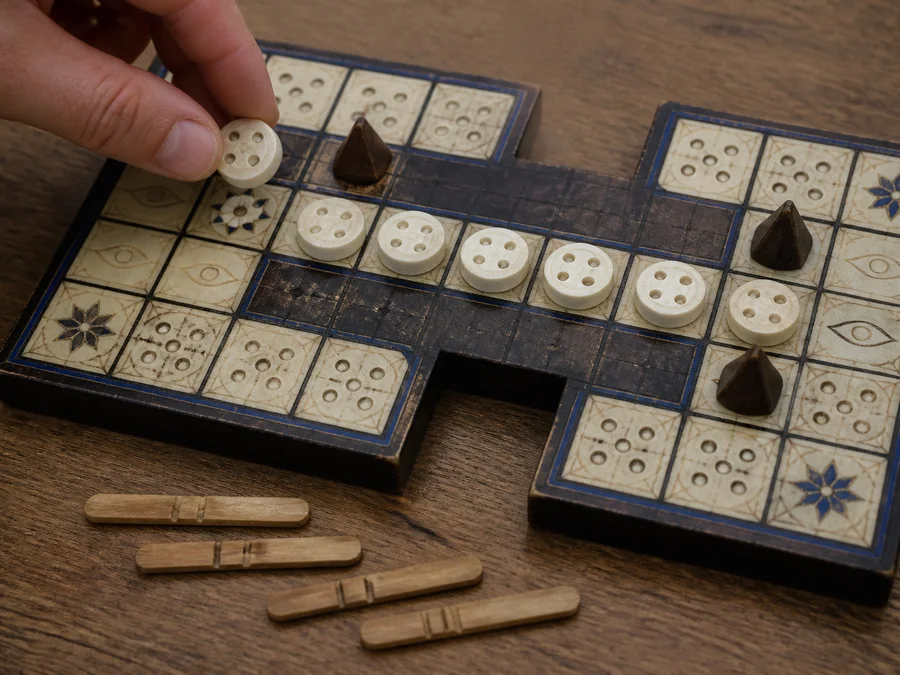
Beginner Opponent: Gives you room to learn move flow without much pressure. Good for getting comfortable with entry, captures, and exact bear-off.
Gentle Practice: Starts taking rosettes and obvious captures, so sloppy play stops feeling free.
Advanced Practice: Punishes weak timing much more often. Return captures, extra rolls, and crowded alley positions get harder to survive.
Strong AI: Exposes bad piece distribution and short-sighted captures. If you only planned for one roll, you usually feel it right away.
Play as White or Black. Hints use the same evaluation level as the AI you picked, while undo and replay help you study the turns where tempo flipped, a rosette changed the race, or an exact bear-off showed up one move too late.
20squares on the reconstructed board
7pieces per side
0–4from four binary sticks
Offall seven must bear off
Common questions
Which rules does this version of the Royal Game of Ur use?
It follows the reconstruction Irving Finkel worked out at the British Museum, which is the version most people play today. Each side has seven pieces, four binary sticks give a roll from 0 to 4, landing on a rosette earns another roll, a piece on the central rosette can't be captured, and the first player to bear all seven off wins.
Are the rolls random, and why does 2 come up so often?
Each stick has an even chance of landing marked side up, and the roll is how many do. That makes the numbers uneven: 2 turns up about three times in eight, 1 and 3 a quarter of the time each, and 0 or 4 only once in sixteen. Plan around a likely 2 rather than hoping for a 4.
What happens when I roll a 0 or none of my pieces light up?
Your turn passes and the other side rolls. A 0 always passes. Any other roll passes too when every piece would land on one of your own, run into an opponent sitting on the central rosette, or overshoot the exit. Nothing is stuck; that's simply the rule.
Why can't my piece leave the board when it's one step away?
Bearing off needs the exact number. A piece two squares from home leaves on a 2, and a 3 or 4 won't do. Near the end, try not to stack several pieces at the same distance from the exit, so more rolls give you something useful to play.
What happens to a captured piece, and which squares are safe?
It goes back to the start and has to make the whole trip again. Each side's opening and closing lanes are out of the opponent's reach; only the shared middle lane allows captures. The central rosette is the exception: a piece resting there can't be hit, and the other side can't land on it.
Does the AI know what it's going to roll next?
No. Every roll is made fresh, and the AI sees exactly what you see. Its edge is weighing how likely each future roll is, so it knows which moves leave a piece exposed and when a rosette is worth taking. Higher levels look further and make fewer careless moves.
How do I use hints, undo and replay without just copying the AI?
Pick a piece yourself first and decide what the move is for, whether that's grabbing a rosette, stepping out of reach, or setting up a clean exit. Then check the hint. It plays at your current AI level, not some stronger hidden engine. Undo lets you retry a fork in the road, and replay shows where the game started slipping away.
Can I choose White or Black, and who rolls first?
Against the AI you can switch sides in the sidebar. White always rolls first, so White means you open the game and Black means the AI moves first. Switching starts a fresh game; the current one isn't carried over.
If I close the page, is my game still there?
Usually, yes. Games against the AI are saved in this browser on this device, with a separate game kept for White and for Black. Another device, another browser, or clearing this site's data means starting over.
Do I need an account or an app to play?
Neither. Open the page and play on a phone or a computer, with no email or password involved. If you'd like a one-tap shortcut, you can add the site to your home screen, but the game works the same without it.